Remittance advice
Paid against a low benchmark
Insurers pay what they choose, measured against the qualifying payment amount: a benchmark a federal appeals court found artificially low.
UnderpaidFederal and state IDR, handled from claim to payment.
Millions
recovered for clients
Many clients recover
75–90%
of billed charges
Varies with your chargemaster
~$100M
under management
The problem
The No Surprises Act gave providers a way to dispute low payments. It also gave them strict rules, tight clocks and an insurer on the other side arguing every claim.
Remittance advice
Insurers pay what they choose, measured against the qualifying payment amount: a benchmark a federal appeals court found artificially low.
UnderpaidFinal offers
In IDR each side submits a single offer and the arbitrator picks one. Nothing in between. The better-supported case wins.
SelectedNotice of IDR initiation
30 business days from payment to open negotiation, 30 more to negotiate, then 4 to file. Miss a window and the claim can be forfeited.
ForfeitedEligibility objection
Insurers routinely argue that claims don’t qualify. Industry-wide, about one dispute in five is dismissed.
DismissedSources: Texas Medical Ass’n v. HHS (5th Cir.); CMS Federal IDR public use files, 2025.
Illustrative
+$756.80
A loss can still pay. When the payer’s $3,500 offer is selected, you still net $756.80 above the $2,000 initially paid, after fees.
Most providers contest only a fraction of eligible claims, because the process is too slow and too manual to do at scale. The rest is revenue left on the table.
How it works
IDR Advocate connects to the systems you already use and runs every step of federal and state IDR.
We pull qualifying claims from your EHR and batch them under the federal batching rules, so even small disputes are worth filing.
We open negotiation on every eligible claim, send the notices and track every negotiation window, federal or state.
Each case is built from your own records and cited to the literature, then sharpened with our QPA models and caselaw.
We file in the right forum inside every deadline, manage IDR entity selection and answer objections with the facts and the law.
We follow every determination to payment, match remittances and chase variances until the account closes. How payment works →
Recovery, payer behavior and outcomes in one place, so each new filing learns from the last.
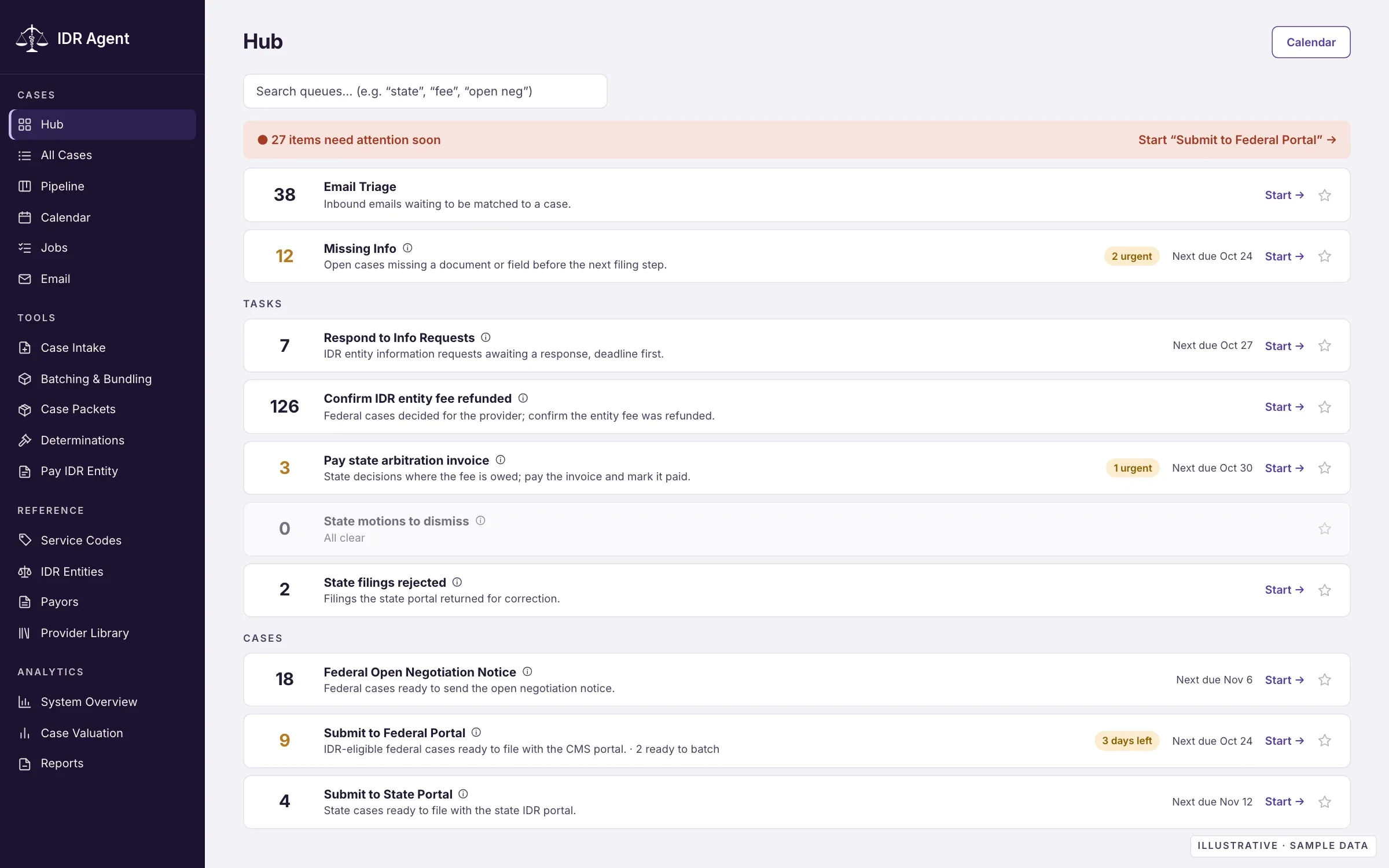
Command center
See your whole IDR portfolio by stage, payer and service line. Deadlines count down on their own, high-value cases rise to the top and nothing waits on a spreadsheet.
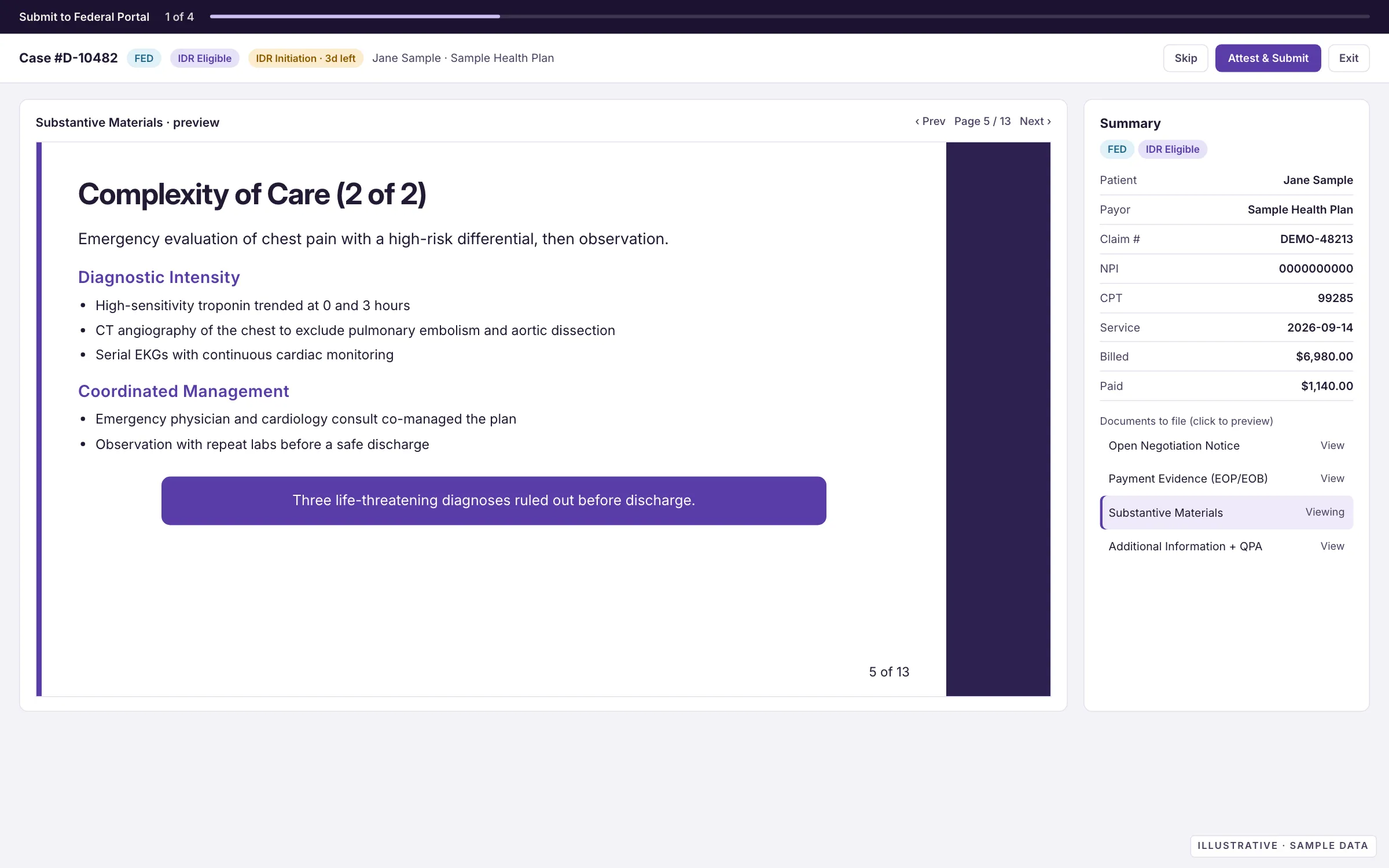
The brief
We build each brief from your own records: patient acuity, complexity of care and your clinicians’ training, all cited to the literature. Proprietary QPA machine-learning models and analysis of caselaw, from Guardian Flight to TMA III, do the rest.
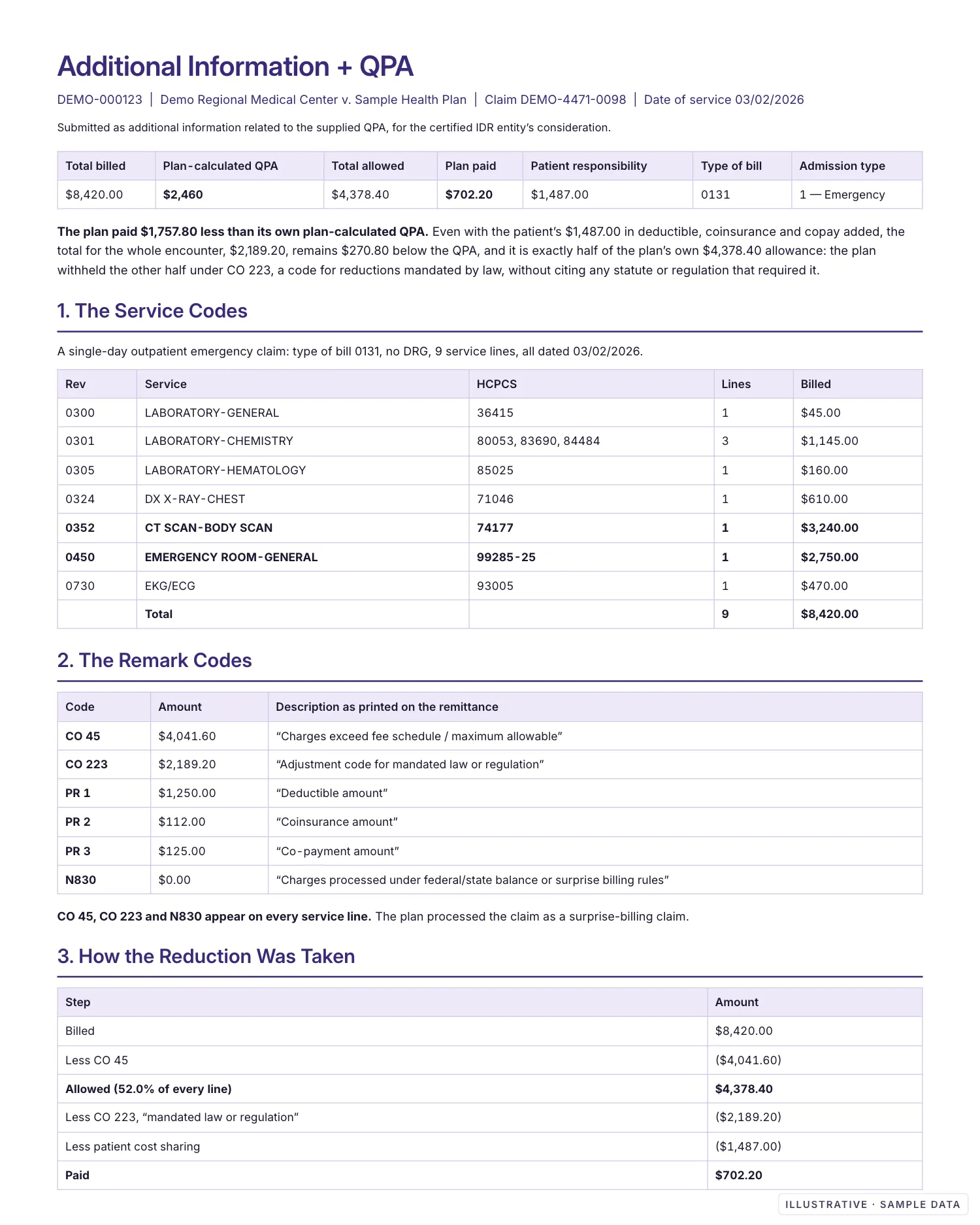
QPA counters
Plans anchor on the QPA, and many pay less than it. We rebuild the payment from the remittance, line by line, and file a counter that shows the IDR entity exactly where the plan’s number falls apart.
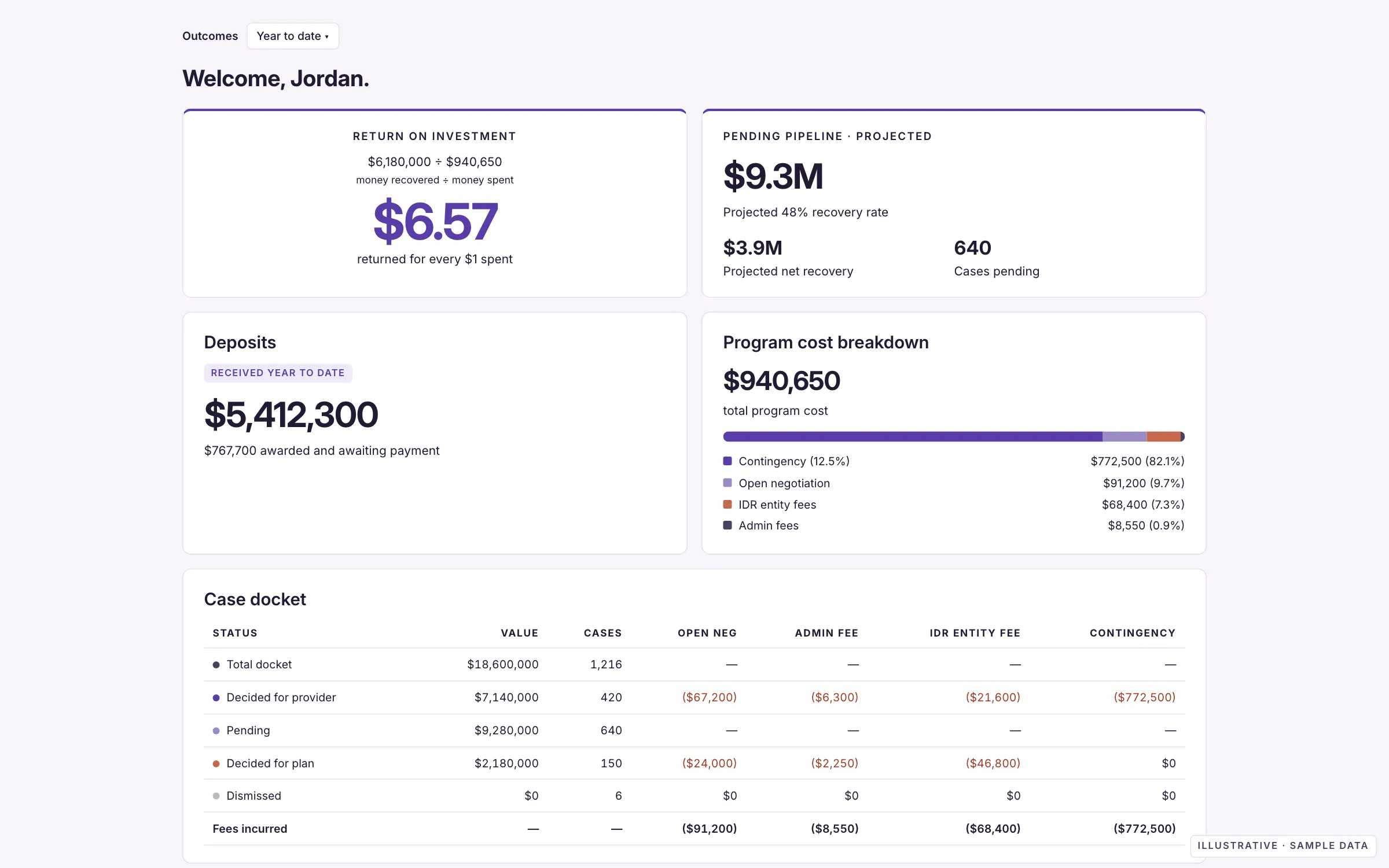
Finance & analytics
Accounting is told when a claim enters IDR, what to expect and when. Collections pause during active disputes, payments are matched to determinations and every variance gets followed up.
Connects to data from Epic · Cerner · Athena · FinThrive · Federal & state IDR portals · Slack & Teams
Some systems are white-glove: we build those integrations as part of our agreement with your health system. Product names are trademarks of their owners.
Learn
The scoreboard
Federally, providers are selected in 80–90% of disputes. A high count is easy if you ask for less. We ask for full value.
What most advocates report
80–90%
of federal disputes won
Easy to reach if you ask for less.
What we measure
75–90%
of billed charges recovered
For many of our clients. Results vary with your chargemaster. The examples below use separate assumptions and deduct example fees.
One dispute
Each side submits one final offer, and the arbitrator picks the one closer to its view of value. To win, the payer has to raise its offer toward that value.
Final-offer arbitration
Illustrative
Net lossNet gain
Versus the $2,000 Initially Paid
+$756.80
Net gainLose at $3,500 and still net $756.80 above the $2,000 initially paid. Illustrative: the losing side pays the IDR entity fee ($450 here); the transaction fee is $293.20 per case.
100 disputes
Ask for 100% of billed charges on every claim. When the payer defaults, you’re paid in full. When it contests, it has to raise its offer to win.
100 claims, each Initially Paid $2,000
Illustrative
Payer defaults (18): paid $6,000You win (20): paid $6,000Payer wins (62): paid $3,500
Versus the $200,000 Initially Paid
+94%
Cases won: 38 of 100.
Net gainIllustrative. Your offer is 100% of billed charges ($6,000); a payer that wins offers $3,500. The loser pays the $450 IDR entity fee, including a payer that defaults; the transaction fee is $293.20 per case. In 2025, payers defaulted in about 18% of federal disputes (CMS Federal IDR public use files).
Pricing the offer
Ask for less and you win more cases. Ask for full charges and you collect more money.
The same 100 claims
Illustrative
Your offer
100%
of billed charges · $6,000
Cases won
38
of 100
Net vs. Initially Paid
+94%
$387,780 net
| Your offer | Cases won | Net to you | Vs. Initially Paid |
|---|
Illustrative model on the same 100 claims: initially paid $2,000, billed charges $6,000, benchmark $4,000, 18% payer defaults, fees as above. The arbitrator’s view of value varies around the benchmark. The payer’s offer is held at $3,500; in practice payers offer less when you ask for less, so lower asks would do worse than shown.
The record
Arbitrators must weigh these factors. We document every one. We never miss a filing.
42 U.S.C. § 300gg-111(c)(5)(C)
Federal and state
Federal
Providers win most disputes. The question is how much you collect.
State
Each state sets its own benchmark, batching and fees.
Example: Georgia
Arbitrators see the FAIR Health median, and each request covers up to four patients.
See Georgia law →Examples are illustrative. Federal figures: CMS Federal IDR public use files, 2025. Recovery varies with your chargemaster, payers and states.
The process
The federal process, step by step, with the details that decide real disputes.
01 · Eligibility and forum
Federal IDR covers emergency care, care by out-of-network clinicians at in-network facilities, and air ambulance, for plans the No Surprises Act covers. Medicare, Medicaid, CHIP and TRICARE are outside it. Where a state law reaches the plan, the provider and the service together, the state process applies instead.
The nuance
02 · Open negotiation
Open negotiation must start within 30 business days of the plan’s initial payment or denial, by sending the standard notice. If the two sides do not agree within 30 business days, either can start IDR.
The nuance
03 · Filing and batching
After negotiation ends, either side has 4 business days to start IDR. Similar claims can be combined into one dispute to share fees.
The nuance
04 · Offers and evidence
Each side submits a single number and the evidence behind it. The IDR entity weighs the factors below, and no factor, including the QPA, is presumed correct.
The nuance
05 · Decision
The IDR entity must decide within 30 business days of being selected, and it picks one offer, nothing in between. The losing side pays the entity’s fee.
The nuance
06 · Cooling off
After a decision, the side that started the dispute must wait 90 calendar days before filing again for the same or similar service against the same plan.
The nuance
07 · Getting paid
The plan must pay a federal award within 30 calendar days of the decision. In Georgia, the losing side pays within 15 days and the winner is paid within 3 days after that.
The nuance
Summary for general information, not legal advice. Federal rules as of October 2026.
The factors
Each side submits one final offer. The arbitrator picks the one that best represents the value of the care, weighing the benchmark and these factors.
The benchmark
The plan’s median contracted rate for the same service in the area. The arbitrator must consider it, and a federal appeals court found it artificially low.
Evidence that helps: The plan’s QPA disclosures, and proof of where it is miscalculated.
Factor 1
How sick the patient was, and how hard the care was to deliver.
Evidence that helps: Diagnoses, severity, procedures performed, and the time and resources used.
Factor 2
The skill of the clinicians and the results they deliver.
Evidence that helps: Board certification, specialty training, experience, and quality and outcome measures.
Factor 3
The share of the local market held by the provider or by the plan.
Evidence that helps: Local market data for the service line and the plan’s enrollment in the region.
Factor 4
For facilities: what the hospital is and what it is equipped to do.
Evidence that helps: Teaching affiliation, case-mix index, trauma designation and service lines.
Factor 5
Each side’s efforts to agree on a network contract, and any contracted rates in the past four years.
Evidence that helps: Contract offers, negotiation history and prior contracted rates.
Federal IDR: 42 U.S.C. § 300gg-111(c)(5)(C)–(D); 45 C.F.R. § 149.510(c)(4). States weigh their own lists; see each state below.
Every state
Federal IDR covers every state. Some states add their own process for the plans they regulate. Click a state to see its rules.
State process + federalState law; hospital claims go federalFederal IDR only
Click a state to see which process applies.
Onboarding
White-glove implementation with minimal disruption to the way your team works today. If your internal reviews take longer, we work at your pace.
We review your EHR, revenue-cycle and contract systems, map your claims data and sign the BAA and NDA before any data moves.
We connect by API, SFTP, HL7/FHIR or on-premises, load six months of history as a baseline and set QPA thresholds, timelines and user roles.
Your leadership sees the platform running on your own data, with ROI projections. Users are trained in a few short sessions.
We run test claims end to end, then launch with daily check-ins through the first week and real-time issue resolution.
ROI
Most of the value is in the claims you aren’t disputing today. Adjust the numbers to match your organization.
FAQ
Independent dispute resolution is the No Surprises Act’s process for settling out-of-network payment disputes between providers and health plans. Open negotiation must start within 30 business days of the plan’s initial payment or denial. After 30 business days of negotiation, either side can initiate IDR within 4 business days. Each side then submits one offer, and a certified IDR entity picks one. Many states also run their own process for the plans they regulate; we file in whichever forum applies.
Emergency care, care by out-of-network clinicians at in-network facilities, and air ambulance, under plans the No Surprises Act covers. Medicare, Medicaid, CHIP and TRICARE are excluded, and some states run their own process. We screen every claim for eligibility and the right forum, federal or state, before it’s filed.
No. We connect to the EHR and billing systems you already use, including Epic, Cerner, Athena and FinThrive, by API, SFTP, HL7/FHIR or an on-premises server. Some systems are white-glove: we build those integrations as part of our agreement with your health system.
A 2–3 hour discovery session, a few short training sessions per user, brief daily check-ins during launch week and a weekly optimization call after that. Deadlines, filings and follow-up are ours.
Both. The platform handles intake, deadlines, briefs and reconciliation. For high-value or complex cases, expert reviewers can check the brief before it’s submitted.
Prove it on your own claims in 90 days. Start with one state or one payer, see the results, then expand.
Legal
At IDR Advocate (together, with our affiliates, “Company”, “we”, “our”, or “us”), we value your privacy and are committed to protecting your data. This Privacy Notice explains how we collect, use, disclose, and safeguard user (hereinafter, “user”, and “you”) information when you visit our website or use our services in order to improve your experiences. By accessing or using our services, you agree to the terms outlined in this notice.
We encourage you to read this Privacy Notice carefully to understand our practices regarding your information and how we will treat it. If you have any questions or concerns about our policies or your privacy rights, please reach out to us at sales@idradvocate.com.
User Consent. In consideration of Company services and good, user manifests an intention to be bound by this Online Privacy Notice. This agreement ONLY the IDR Advocate public website, and NOT any services provided through IDR Advocate, after a user logs in.
Information We Collect. The Company may collect User Information to improve services, models, and other goods.
Personal Identifying Information. In order to make services available, Company will request users provide certain personal information (hereinafter “Personal Identifying Information” or “Personal Information”), including identifying information, such as name, postal address, e-mail address, screen name, password, telephone number, method of payment, credit card number, and other applicable information. Company may request additional information, as the Company discerns as relevant. If user communicates with Company, this information is also recorded. Company also retains multiple social media sites, and when you interact with our pages, we collect information on you
Chat Rooms, Forums, and Bulletin Boards. Any user information, including which may be communicated to Company via any Chat Room, or is related to Company, may be recorded by Company.
User Inputs and Outputs. Unless a privacy exception is applied in all user input and outputs are recorded, including those uploads of documents.
Contact. Company may require a user to input telephone number to Company, and for Company to call, text, or otherwise contact user. Company may contact you for related services. Users should be aware that it is Company’s practice to monitor, and in some cases record, texts and calls for training, quality assurance, and other purposes.
Use of User Information. Company may employ and store all User Information for the following purposes:
Administration. Company may employ collective information for administrative purposes, such as providing customer service, processing or fulfilling orders, inputs, and outputs, verifying user information, processing payments, or providing similar services.
Security. Company may employ user information to improve security, integrity, as is necessary and proportionate to protect Company infrastructure, data, and privacy integrity.
Research. Company may employ user information to debug and identify and repair errors that impair functionality, or is used to draft open-source or close-source research and white papers, and to conduct research on user prefaces, model performance, and adequacy or improvements.
Development and Training. Company may employ user information training or developing Artificial Intelligence (AI) or other models.
Fraud Prevention. Company may employ user information to prevent fraud, or identify and counter other criminal activity.
Business Purposes. Company may employ User Information for business purposes, including identifying potential users, enhancing services, advertising and marketing services, and cross-context behavioral advertising to you or other users, to the extent permitted by law;
Privacy Warrant. The Company warrants that it will employ reasonable industry-standard protections to protect user privacy. Except as provided by the Disclosure provisions of this Agreement, Company will aggregate or de-identify User Information to the extent possible, so that data may not personally identify users.
Disclosure of User Information.
Vendors and Service Providers. Company may disclose User Information to Vendors and Service Providers to improve, provide, and sell services to the user. Such Vendors include, but are not limited to, customer service vendors, cloud services, email communication, web analytics services, and other information technology providers.
Business Transfers. If involved in any strategic transactions, bankruptcy, receivership, merger and acquisition, internal corporate organization (including compliance with any relevant licenses to Company subsidies and partners), agents of the Company, affiliated businesses, marketing analysis by third parties, or services by third party consultants for the use of reasonable business services, Company may disclose User Information, and de-identify or aggregate the information to the extent reasonably possible. This may, in effect, constitute selling User Information, to the extent permitted by law.
Legal Requirements. Company may share or employ User Information with government authorities, industry peers, or other third parties as required by law in good faith that such action is a legal obligation, to protect and defend Company rights or property, to enforce violations of Company terms, policies, or law, and to detect or prevent or prevent fraud or other illegal activity.
Account Administrators. When a user joins the Company, Company employees may access and control account to the extent necessary to assist user in accessing services.
User Rights. Users may, depending on jurisdiction, have statutory rights in relation to user information. Those statutory rights, including access to user information relating to processing and training AI models, deletion of User Information or specific Personal Information, transferring of User Information or specific Personal Information, to withdraw consent, or to file a complaint, can always be exercised by contacting Company. To excise user statutory rights, contact Company at sales@idradvocate.com. Company retains the right to verify user identify and credentials in order to protect User Information. That verification may include personal information, including proof of residency, social security number, and other information. Equally, in the event of an authorized agent on behalf of a user, the agent may be required to demonstrate evidence of agency. Users have the right to appeal any decision, and receive a decision by the Company by contacting sales@idradvocate.com. Users may learn about their rights by contacting Company Data Officer at sales@idradvocate.com
U.S. State Disclosures, Including California. As required by law, the following table discloses the categories and use of User Information by Company.
| What We use your User Information for: | Our reasons: |
|---|---|
| To prevent and detect fraud against you or Company. | For Our legitimate interests or those of a third party, i.e., to minimize fraud that could be damaging for us and for you. |
Conducting checks to identify Our customers and verify their identity. Screening for financial and other sanctions or embargoes. Other processing necessary to comply with professional, legal and regulatory obligations that apply to Our business. |
To comply with Our legal and regulatory obligations |
| Gathering and providing information required by or relating to audits, enquiries or investigations by regulatory bodies. | To comply with Our legal and regulatory obligations. |
| Ensuring business policies are adhered to, e.g., policies covering security and internet use. | For Our legitimate interests or those of a third party, i.e., to make sure We are following Our own internal procedures so We can deliver the best service to you. |
| Operational reasons, such as improving efficiency, training and quality control. | For Our legitimate interests or those of a third party, i.e., to be as efficient as We can so We can deliver the best service for you at the best price. |
| Ensuring the confidentiality of commercially sensitive information. | For Our legitimate interests or those of a third party, i.e., to protect trade secrets and other commercially valuable information. To comply with Our legal and regulatory obligations. |
| Statistical analysis to help us manage Our business, e.g., in relation to our financial performance, customer base, or other efficiency measures. | For Our legitimate interests or those of a third party, i.e., to be as efficient as We can so We can deliver the best service for you at the best price. |
| Preventing unauthorized access and modifications to systems. | For Our legitimate interests or those of a third party, i.e., to prevent and detect criminal activity that could be damaging for us and for you. To comply with Our legal and regulatory obligations. |
| Updating and enhancing customer records. | For the performance of Our contract with third-parties. To comply with Our legal and regulatory obligations. For Our legitimate interests or those of a third party, e.g., making sure that We can keep in touch with Our users about existing orders and new products. |
| Statutory returns. | To comply with Our legal and regulatory obligations. |
| Ensuring safe working practices, staff administration and assessments. | To comply with Our legal and regulatory obligations. For Our legitimate interests or those of a third party, e.g., to make sure We are following Our own internal procedures and working efficiently so We can deliver the best service to you. |
Marketing Our services and those of selected third parties to: —existing and former users and customers; —third parties who have previously expressed an interest in Our services and product; —third parties with whom We have had no previous dealings. |
For Our legitimate interests or those of a third party, i.e., to promote Our business to existing and former customers. |
| Credit reference checks via external credit reference agencies. | For Our legitimate interests or those of a third party, i.e., to ensure Our users are likely to be able to pay for Our products and services. |
| External audits and quality checks, e.g., for accreditations and the audit of Our accounts. | For Our legitimate interests or a those of a third party, i.e., to maintain Our accreditations so We can demonstrate We operate at the highest standards. To comply with Our legal and regulatory obligations. |
| Training artificial intelligence models | For Our legitimate business interests in improving consumer quality for each individual experience. |
Amendments. This Agreement may be changed at any time by Company, upon notice to user. Amendments to this Agreement may be noticed by posting the new policy on the medium in which Company provides the Online Privacy Notice.
Severability. If any provision of this Agreement is found to be invalid, illegal, or unenforceable by a court, such provision shall be deemed modified to the extent necessary to make it valid and enforceable. If such amendment or modification is not possible, it shall be severed from the Agreement, and the remaining provisions of the Agreement shall continue in full force and effect. If the arbitration provision found in section 12 is unconscionable or unenforceable, then the Company shall select a sufficiently impartial arbitrator. If the Company’s choice of an arbitrator is insufficient, then the Court shall select an arbitrator. If the Court selects an arbitrator, and the arbitrator finds damages against the Company exceeding $1,000,000, then the Court shall vacate the arbitrator’s findings, and proceed through normal litigation. If the arbitrator’s findings are vacated, neither party may employ the arbitrator’s findings in litigation, and such findings shall remain under seal.
Entire Agreement. Except as required by law, this Agreement constitutes the entire Agreement to which there is a manifestation to be bound. This clause shall be construed to enforce the Parol Evidence Rule to exclude evidence that contradicts or modifies this written contract.
Arbitration. Any controversy or claim arising out of or relating to this Agreement, or the breach thereof, shall be settled by binding arbitration administered by IDR Advocate, employing AI systems owned, licensed, and or operated by IDR Advocate, in accordance with the IDR Advocate Early Access Rules and Procedures. The decision of IDR Advocate shall be final and binding on the parties and shall not be appealable to any court or other dispute resolution body. In addition, judgment on the award rendered by IDR Advocate may be entered in any court having sufficient jurisdiction thereof. If IDR Advocate cannot, or refuses to, provide arbitration, the Company may select a neutral arbitrator. BY AGREEING TO THIS ARBITRATION PROCEDURE, THE PARTIES OF THIS AGREEMENT WAIVE THE RIGHT TO RESOLVE ANY SUCH DISPUTES THROUGH A TRIAL BY JURY OR JUDGE OR THROUGH AN ADMINISTRATIVE PROCEEDING. IDR Advocate shall have the sole and exclusive authority to determine whether a dispute, claim, or cause is subject to arbitration under this Agreement, to determine any procedural questions which grow out of such disputes, claims, or causes of action, and to render a final decision. The party initiating the arbitration shall be responsible for paying all administrative fees charged by IDR Advocate for the arbitration, except as required by law; however, if the party initiating the arbitration is ultimately successful in the arbitration, the non-initiating party shall be responsible for such fees, except as required by law. NOTICES UNDER THIS PROVISION MAY BE SERVED BY ELECTRONIC EMAIL.